The Best Time to Visit Monument Valley, Month by Month
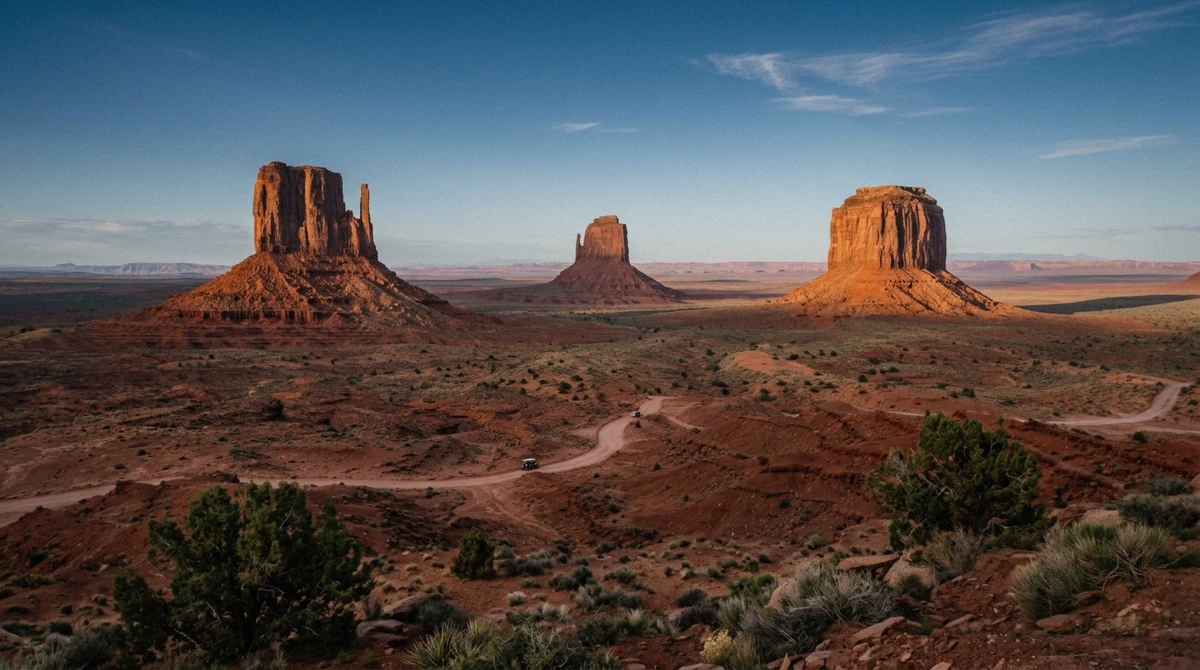
The best time to visit Monument Valley is April, May, September and October, when daytime highs sit in the sixties and low eighties, the light is long enough to work with at both ends of the day, and the valley is not being cooked. That is the short version, and it is the one most guides stop at. The longer version matters more, because this is high desert at 5,564 feet where the temperature swings twenty-five to thirty degrees between dawn and mid afternoon in every month of the year, where the rain arrives in a narrow late-summer window, and where the clock itself is set differently from the rest of Arizona. This guide runs the real numbers: temperature and rainfall normals from the national weather record, sunrise and sunset times for every month, and what each of those actually does to a day in the valley.
Quick answer
April, May, September and October are the best months: highs of 67°F to 82°F, cool mornings, and enough daylight at each end for a dawn or dusk departure without an unreasonable alarm. July is the hottest month at an average high of 92.9°F, and August and September carry the monsoon rain. December and January are the quietest, with average highs near 41°F and lows near 25°F, and the shortest gate hours of the year.
Key takeaways
- Best overall: April, May, September and October, warm days and cold mornings, with Navajo-guided jeep tours run year round in every season
- Hottest: July, average high 92.9°F, which is why the dawn departure is the one to book in summer
- Wettest: September at 0.82 inches and August at 0.74 inches, the North American monsoon window
- Quietest and coldest: December and January, average highs near 41°F, and the tribal park's winter last entry drops to 2:30 pm
- The clock trap: the Navajo Nation observes daylight saving time while most of Arizona does not, so the golden-hour run may start an hour earlier than your phone habit expects
- Staying close is what makes an early start workable, see where to sleep so you can make a sunrise start
The Short Answer, and Why It Holds
Four months do the heavy lifting here. April and May bring average highs of 67.3°F and 77.0°F with lows of 42.1°F and 53.5°F, which means a jacket at the meeting point and shirtsleeves by mid morning. September and October run 82.1°F and 69.4°F by day and 58.3°F and 45.5°F at night, with the added advantage that the low autumn sun rakes across the buttes for longer than it does in June.
Those are the windows where nothing about the weather is working against you.
The months either side are not bad, they are specific. June is genuinely dry at 0.19 inches of average rainfall and already hot at 88.6°F, and it has the earliest sunrise of the year, which makes a dawn trip a pre-6:00 am commitment. November through March is cold, clear and empty, with the trade-off that the tribal park runs shortened winter hours.
Nothing here closes for the season: Navajo Nation Parks & Recreation keeps the park open all year apart from Thanksgiving Day, Christmas Day and New Year's Day.
Departures That Suit Each Season
Which trip you book matters more in some months than others. In summer the dawn departure is the difference between a comfortable morning and a hot one; in winter the light is good enough all day that any departure works.
 from $78.20
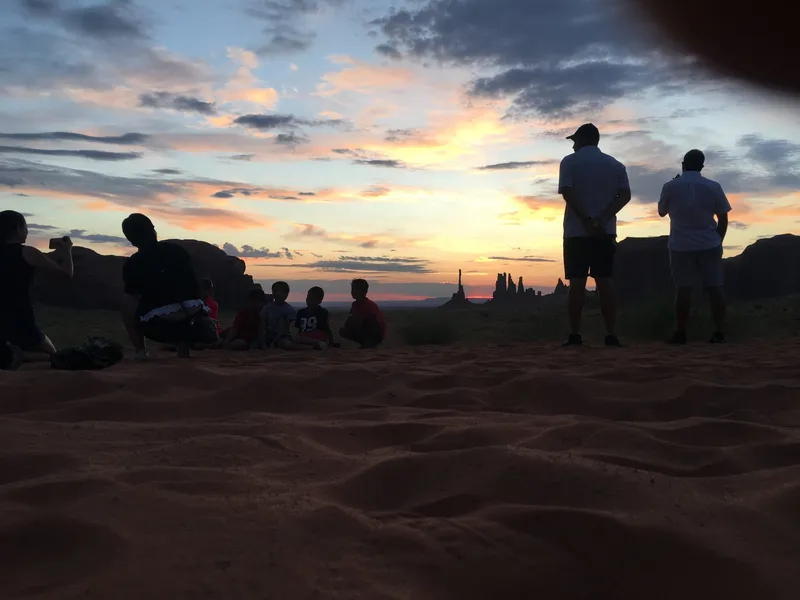
 Monument Valley Sunrise Jeep Tour with Navajo Guide
Discover the wonders of Monument Valley at dawn. Admire the glowing sunrise across iconic landscapes, then ride through the valley with a Navajo guide to learn about its…
- Sunrise glow across the buttes
- Navajo guide and open-air 4x4
- Quiet valley before the crowds
- Stories of natural landmarks
 from $78.20
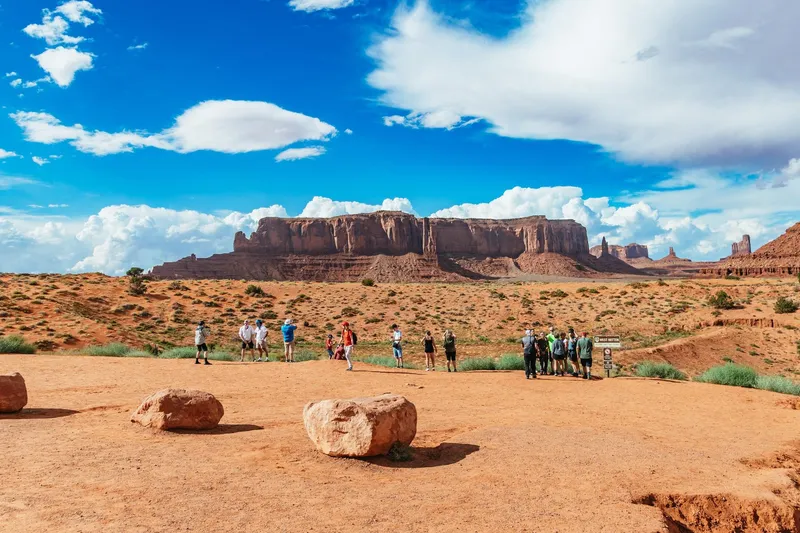
 Monument Valley Sunset Jeep Tour with Navajo Guide
Witness a stunning sunset over Monument Valley's iconic towering red sandstone buttes. Experience the magic of the changing colors and famous rock formations as the sun sets, with…
- Golden-hour light on the red buttes
- Navajo guide and open-air 4x4
- Changing colors across the valley
- Prime sunset photography stops
 from $68.43
 Monument Valley Backcountry Jeep Tour with Navajo Guide
Explore Monument Valley and its restricted backcountry with a Navajo guide aboard an open-air 4x4. See landmarks such as the Mittens, Totem Pole, and hidden arches that can…
- Open-air 4x4 jeep through restricted backcountry
- Navajo guide sharing valley history and legends
- Up-close views of the Mittens and Totem Pole
- Access to areas closed to self-drive visitors
Month by Month: Temperature and Rainfall
These are climate normals, not forecasts. Temperature figures come from the National Oceanic and Atmospheric Administration's National Centers for Environmental Information, 1991 to 2020 U.S. Climate Normals, Monument Valley, Arizona station. Precipitation comes from the same data set at the Mexican Hat, Utah station about twenty miles north, which is the nearest station in the record that publishes rainfall normals.
| Month | Average high | Average low | Average rainfall | What that means on the ground |
|---|---|---|---|---|
| January | 41.4°F | 24.8°F | 0.67 in | Cold, clear, empty. Gloves at the meeting point. Winter gate hours. |
| February | 47.7°F | 28.7°F | 0.60 in | Still cold, days lengthening, the quietest month that is not bitter. |
| March | 59.2°F | 35.6°F | 0.44 in | Warming fast. Windy. Daylight saving starts and the clocks move. |
| April | 67.3°F | 42.1°F | 0.31 in | One of the four best months. Wind is the only complaint. |
| May | 77.0°F | 53.5°F | 0.49 in | Warm days, comfortable mornings, long useful light. |
| June | 88.6°F | 64.7°F | 0.19 in | The driest month and getting hot. Earliest sunrise of the year. |
| July | 92.9°F | 67.9°F | 0.54 in | The hottest month. Monsoon storms begin building in the afternoons. |
| August | 89.7°F | 65.0°F | 0.74 in | Hot and the second wettest month. Afternoon storms are common. |
| September | 82.1°F | 58.3°F | 0.82 in | The wettest month on paper, and still one of the four best to visit. |
| October | 69.4°F | 45.5°F | 0.66 in | Arguably the pick of the year. Warm, low sun, thinning crowds. |
| November | 53.0°F | 33.6°F | 0.42 in | Cold mornings, short days, the clocks go back early in the month. |
| December | 41.1°F | 24.9°F | 0.45 in | The coldest month alongside January. Very quiet. |
Two patterns are worth pulling out of that table. The first is the daily swing: in every single month the gap between the average high and the average low is between twenty-five and thirty degrees. That is what altitude does to a desert, and it is why layers are not optional advice here even in July.
The second is that annual rainfall totals only about 6.3 inches, so rain is rarely the thing that spoils a visit. When it does interfere it is concentrated in the late-summer monsoon, where the problem is less the rain itself than what it does to an unpaved road.
What the monsoon actually changes
From July into September, moisture pushes up from the south and builds into afternoon thunderstorms. They are usually short, they are often spectacular to watch, and they can turn the surface of the unpaved loop road to deep sand and rough going. Navajo Nation Parks & Recreation posts a standing monsoon-season notice about rough terrain and deep sand dunes on the loop drive, and warns of long wait times.
A guided trip rides a high-clearance vehicle over that surface with a driver who knows it; the same conditions are what make an ordinary rental car a poor bet in those weeks. The park fees, road conditions and gate hours are covered in full separately.
Sunrise and Sunset Through the Year
The single most practical planning number for a valley built around light is what time the sun actually appears. These are mid-month times for the park, in local Navajo Nation time with daylight saving applied. Round them in your head, and treat them as the moment the sun clears the horizon, not the moment the good light starts.
| Month | Sunrise | Sunset | Length of the useful window |
|---|---|---|---|
| January | around 7:35 am | around 5:30 pm | Short day, but the low sun means good light almost all of it |
| February | around 7:10 am | around 6:00 pm | Civilised dawn start, cold at the meeting point |
| March | around 7:35 am | around 7:30 pm | Sunrise looks later because the clocks moved forward |
| April | around 6:45 am | around 8:00 pm | Long evenings return |
| May | around 6:15 am | around 8:20 pm | Early alarms begin |
| June | around 6:00 am | around 8:40 pm | Earliest sunrise, latest sunset, highest and harshest midday sun |
| July | around 6:15 am | around 8:40 pm | Same long day, more heat and cloud |
| August | around 6:40 am | around 8:15 pm | Storm light in the afternoons |
| September | around 7:05 am | around 7:30 pm | The balance point of the year |
| October | around 7:30 am | around 6:45 pm | Comfortable alarm, long low light |
| November | around 7:00 am | around 5:10 pm | Clocks go back; the afternoon closes quickly |
| December | around 7:30 am | around 5:05 pm | Shortest day, and the whole golden hour fits into a reasonable morning |
The practical read: in June a dawn departure is a pre-6:00 am commitment and you will be meeting in the dark, while in December sunrise is after 7:15 am and the entire golden hour sits inside a normal morning. If you are not a natural early riser and you want soft light on the buttes, winter does you a favour that no other season does.
The Clock Trap That Catches Nearly Everyone
This is the fact that ruins more Monument Valley mornings than weather does. The Navajo Nation observes daylight saving time, while most of Arizona does not. From the second Sunday in March to the first Sunday in November, Monument Valley runs on Mountain Daylight Time, which puts it on the same clock as Utah, Colorado and New Mexico, and one hour ahead of Phoenix, Flagstaff and the town of Page.
For the rest of the year the Navajo Nation is back on Mountain Standard Time, the same as all of Arizona. The Navajo Nation's stated reason is to stay on the same clock as Diné communities and services in Utah and New Mexico.
What that does to a traveller is straightforward and expensive. If you sleep in Page or Flagstaff in July and drive up for a 5:30 am meeting time, that meeting time is in valley time, which is an hour earlier than the clock in your hotel room. People miss departures over this every summer.
Antelope Canyon, also on Navajo land, keeps the same daylight saving clock; the town of Page around it does not. Set your phone to update automatically, confirm the meeting time with the operator in valley time, and add a buffer.
Season by Season, and What Each One Is Good For
Spring, March to May
The valley warms quickly and the crowds have not fully arrived. April and May are among the four best months on any honest reading of the numbers. The one real complaint is wind: spring is the windiest part of the year here, and wind in a dry valley means dust, which matters if you are riding in an open vehicle or changing a lens.
Bring something for your face and something for your camera front element.
- Average highs climbing from 59.2°F in March to 77.0°F in May
- Cold mornings, 35.6°F to 53.5°F, so layers at the meeting point
- The driest stretch of the year alongside June
- Wind and blown dust are the season's real nuisance
Summer, June to August
Hot, busy and the only stretch where the weather can genuinely make you uncomfortable. July averages 92.9°F and there is no shade on the valley floor. The answer is not to avoid summer, it is to move your visit to the ends of the day.
A dawn or dusk departure in July is a different experience from a midday one, and the midday hours are also when the light is flattest. Carry far more water than feels necessary and expect afternoon storms from July onward.
- Average highs of 88.6°F to 92.9°F, with no shade on the valley floor
- June is the driest month of the year at 0.19 inches
- July and August bring the monsoon and its afternoon storms
- Dawn and dusk departures are the sensible choice, not a luxury
Autumn, September to November
The best light of the year and, from late September, thinning crowds. September still averages 82.1°F by day and carries the highest average rainfall on the record at 0.82 inches, so it is warm and can be showery. October is the sweet spot.
November cools sharply to a 53.0°F average high and the clocks go back early in the month, which shuts the afternoon down around 5:10 pm.
- September 82.1°F and October 69.4°F, both comfortable by day
- Low sun angles give long shadows across the valley floor
- Autumn nights drop to 58.3°F in September and 45.5°F in November
- The first Sunday in November returns the valley to standard time
Winter, December to February
The quietest and in some ways the most photogenic season. Average highs of 41°F and lows near 25°F mean genuinely cold mornings in an open vehicle, and this is the one season where the clothing advice is not negotiable. The compensations are real: fewer people, hard clear air, a sun that never climbs high enough to flatten the rock, and a late sunrise that makes the good light easy to reach.
The constraint to plan around is the tribal park's winter schedule, where the Scenic Drive stops admitting vehicles at 2:30 pm.
- Average highs of 41.4°F in January and 41.1°F in December
- Lows near 25°F, so a serious coat, gloves and a hat for open-air departures
- Winter last entry to the Scenic Drive is 2:30 pm
- Closed on Thanksgiving Day, Christmas Day and New Year's Day
Pack for a thirty-degree swing, whatever the month
The daily temperature range here sits between twenty-five and thirty degrees in every month of the record, and an open-air vehicle moving at speed makes the morning feel colder than the number. This list works in July and in January; only the weight of the outer layer changes.
- A warm outer layer for the meeting point, even in summer, when dawn lows average 67.9°F in July but 24.8°F in January
- Something to cover your face against blown dust, which is worst in spring
- Sun protection at any temperature, since the valley floor sits at 5,564 feet with no shade
- More water than the day seems to need, especially June through August
- Closed shoes, because you will step out onto sand and loose rock
- A lens cloth or a way to keep dust off a camera front element
Pick Your Month by What You Want
If you want the best all-round conditions and only get one shot
come in October, when highs sit at 69.4°F, the light is long and low, and the monsoon has passed.
If you are travelling with anyone who struggles in heat
avoid June through August entirely, or book a dawn departure and be off the valley floor by mid morning.
If you want the valley close to empty
come in December, January or February and accept 25°F mornings in an open vehicle.
If you are chasing dramatic skies rather than clear ones
August and September bring the monsoon's storm light, at the cost of a rougher road surface.
If you hate early alarms but want soft light
visit between November and February, when sunrise falls after 7:00 am.
If your dates are already fixed
book at the ends of the day whatever the month, since midday light here is the flattest of the day in every season.
Sunrise or Sunset, and How the Season Changes the Answer
Both work, and they are not interchangeable. The buttes face east, so sunrise puts direct light on the faces you recognise from photographs, with the valley floor still in shadow behind them. Sunset comes at the rock from the side, which is what produces the long shadows stretching across the sand that the valley is known for.
Dawn departures also have the valley closer to empty, since fewer people commit to the alarm.
Season decides how much that alarm costs you. In June sunrise is around 6:00 am, so a dawn departure means meeting in the dark before 5:30. In December it is around 7:30 am and the same trip is an ordinary morning.
Dusk runs the opposite way: a June sunset departure near 8:40 pm makes for a late finish, while a December sunset near 5:05 pm is done before dinner. Dawn and dusk departures both run $78.20 to $85 depending on the operator, so cost is not the deciding factor.
The Worst Time to Come, Honestly
If you are asking which window to actively avoid, it is the middle of a July or August day. The average high is near 93°F, there is no shade anywhere on the valley floor, the light is at its flattest, the crowds are at their peak, and the afternoon is when the monsoon storms build. Nothing about that combination shows the place well.
It is not that the park is worse in summer, it is that midday in summer is the worst version of every variable at once.
The second answer is more specific and catches people out: arriving in the afternoon in winter. The Scenic Drive stops admitting vehicles at 2:30 pm in winter hours, so a party rolling in from Moab at three in the afternoon in January finds the gate closed to them even though there is daylight left. If your arrival day is a driving day and the season is winter, plan the valley for the following morning rather than that afternoon, and check by phone, since the park does not publish the calendar dates on which the seasonal hours switch.
There is no month here that is a mistake, only months that ask more of you. Come in October or April and the valley meets you halfway. Come in July and you trade comfort for long days and storm skies, which some people want.
Come in January and you trade warmth for an empty valley and a sun that never gets high enough to flatten anything. What does not change with the season is the line between the public loop and the restricted country behind it, which is why most visitors end up booking a guide whatever month they pick.
Whichever dates you land on, check the clock twice, pack for a thirty-degree swing, and give the light the ends of the day rather than the middle. Ready to lock it in, find a departure for your dates among the Navajo-guided trips running this season.
Frequently Asked Questions
What is the best month to visit Monument Valley?
October, on the balance of the numbers. Average highs of 69.4°F, lows of 45.5°F, a sunrise around 7:30 am that does not require a brutal alarm, low sun angles that flatter the rock all day, and the monsoon already past. April, May and September are close behind. The backcountry departure runs year round, so the month is your choice rather than the operator's.
How hot does Monument Valley get in summer?
July is the hottest month with an average high of 92.9°F and an average low of 67.9°F, according to the 1991 to 2020 climate normals for the Monument Valley station. August is close behind at 89.7°F. There is no shade on the valley floor, so the effective heat is worse than the number suggests. Book a dawn departure and carry more water than you think you need.
What time zone is Monument Valley in?
Mountain Time, but with a twist that catches almost everyone. The Navajo Nation observes daylight saving time while most of Arizona does not, so from the second Sunday in March to the first Sunday in November the valley is one hour ahead of Phoenix, Flagstaff and Page. In winter it matches the rest of Arizona. Confirm your meeting time in valley time, not in the time on your hotel clock.
When is the monsoon season in Monument Valley?
July through September. September carries the highest average rainfall at 0.82 inches and August 0.74 inches, against an annual total of only about 6.3 inches. The storms are usually short afternoon events. Their practical effect is on the unpaved loop road, where Navajo Nation Parks & Recreation warns of rough terrain, deep sand and long wait times during the monsoon.
Is Monument Valley worth visiting in winter?
Yes, with two conditions. Average highs near 41°F and lows near 25°F mean an open-air departure is genuinely cold, so dress for it properly. And winter gate hours are shorter, with the Scenic Drive admitting its last vehicle at 2:30 pm. In exchange you get the emptiest valley of the year and a low sun that never flattens the rock. See is a guided trip worth the money for the full price breakdown.
What time is sunrise in Monument Valley?
It ranges from around 6:00 am in June to around 7:35 am in January, in local Navajo Nation time. Mid-month figures for every month are in the sunrise and sunset table above. Remember that these times already include daylight saving, which the Navajo Nation observes and the rest of Arizona does not.
How many days do you need at Monument Valley?
One full day covers it, and one night nearby is what makes that day work. Arriving late afternoon, taking a dusk departure, sleeping close and driving out the next morning is the pattern that gets the most out of the place without rushing.